Why more and more companies are choosing Bricks B2B as an accelerator
Last March, we were at the Webwinkel Vakdagen, where we talked with partners, clients, and other e-commerce professionals. One topic kept coming up in several conversations: Bricks B2B. But what exactly is Bricks B2B, and why is it so popular?
What is Bricks B2B?
Bricks is an accelerator, a pre-built foundation that we use to quickly develop B2B commerce platforms. The foundation for Bricks is Magento, Hyvä, and the Elgentos B2B suite.
You benefit from fast time-to-market, while at the same time retaining ownership of your platform and data. You also keep the freedom to keep developing and add new functionality as your organization grows. The advantages of SaaS, without the drawbacks.
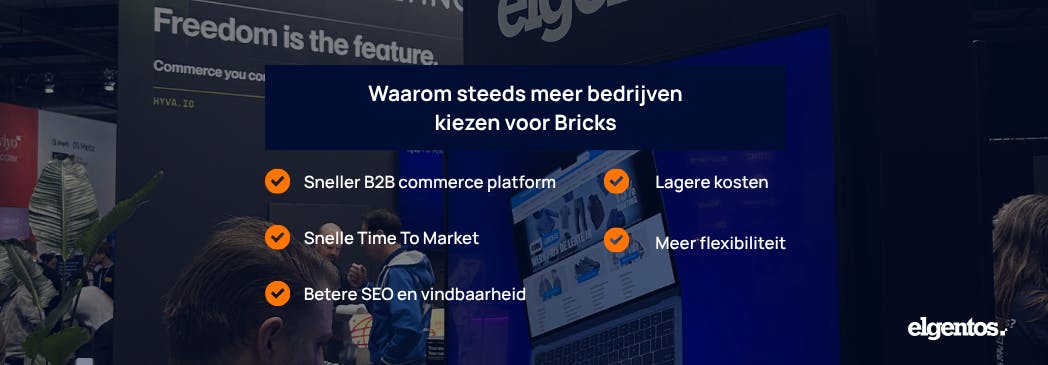
The 5 advantages of Bricks B2B
Bricks B2B offers several advantages. Below, we explain the five most important ones.
Significantly better performance, directly reflected in conversion
Performance is a commercial KPI. Bricks B2B is built on a lean architecture: clean HTML output, a minimal JavaScript footprint, no overhead from heavy page builders, and a significantly reduced dependency on external scripts. The result is measurable in Core Web Vitals (LCP, INP, CLS) that fall well within Google's thresholds, even on product pages with complex configurations and large catalogs.
For the business, this means lower bounce rates, higher conversion, and a better user experience for both buyers in a self-service portal and sales staff during an order entry flow.
Lower Total Cost of Ownership over the entire lifecycle
The initial build costs of a B2B platform are only part of the story. The real costs lie in maintenance, security updates, plugin conflicts, hosting overhead, and the marginal cost of every new feature. Bricks B2B structurally reduces these because fewer external modules are needed, the codebase is more compact and better testable, and upgrades carry less regression risk.
In a typical three-year TCO comparison, this results in a demonstrably lower run-rate, along with fewer unplanned incidents and a more predictable maintenance budget. For CFOs and IT management, this means a platform that doesn't become more expensive after go-live as complexity increases
Accelerated Time to Market for new propositions and campaigns
In B2B, speed of rollout is a competitive advantage. New product lines, customer-specific landing pages, campaign flows, or account-specific pricing pages need to go live within days, not sprints. Bricks B2B is designed around reusable components and a modular content structure, which makes the lead time from concept to production considerably shorter than with traditional Magento implementations.
This increases the agility of marketing and sales, and enables the organization to respond faster to market developments, RFQs, and strategic shifts in the portfolio.
Operational autonomy for marketing and e-commerce teams
As little dependency on the development agency as possible for small changes. Bricks B2B restores the balance: the structural components are solidly built and tested by developers, but content management, page building, and visual adjustments can be handled by the e-commerce team itself. No ticket for a text change, no sprint planning for a new USP block.
This frees up the development team for strategic work and gives marketing direct control over experiments, A/B tests, and optimizations. The pace of iteration increases, and the dependency chain gets shorter.
Structural SEO advantages and stronger organic growth
Search engines reward technically healthy sites. Cleaner HTML, fast render times, correct structured data, semantic structure, and stable Core Web Vitals aren't optional improvements, they're ranking factors. Bricks B2B is built on these foundations, resulting in better indexing, higher positions for commercial search terms, and a stronger organic foundation.
For the business, this means a healthier blended CAC: less dependency on paid acquisition, a larger share of organic and direct traffic, and a more sustainable growth model. SEO thus shifts from a marketing effort to an architectural advantage.
When is Bricks B2B suitable, and when isn't it?
Bricks B2B is not a one-size-fits-all solution, and that's a deliberate choice. The platform is developed for B2B organizations that need a scalable, performant, and manageable commerce foundation without the overhead of a fully custom implementation. Think of wholesalers, manufacturers, and distributors who want to accelerate on digital self-service, customer-specific pricing, and account-based ordering, while retaining control over both the roadmap and operational costs.
The strength of Bricks B2B lies in the combination of a solid standard with targeted room for extension. Where processes lend themselves to configuration over coding, the platform delivers direct value. For organizations with deeply intertwined legacy integrations, unusual fulfillment models, or product logic that fundamentally deviates from common B2B patterns, we're of course happy to build that solution, but through a fully custom-built project instead of within the Bricks B2B framework. We have extensive experience with such complex implementations and see it as one of our strengths to set these up well. The choice between Bricks B2B and a custom project is therefore not a choice between working together or not, but between two different delivery models that both have their place.
In short: Bricks B2B is suitable when speed, manageability, and TCO are the priority. If the business process doesn't fit that, we set up a custom solution that does fully align. We prefer to determine together which route fits best, based on the actual situation and strategic priorities.
What does Bricks mean for your total costs?
By working with an accelerator like Bricks B2B, costs shift away from custom work and complexity toward a stable and predictable foundation. The example below shows how the Total Cost of Ownership (TCO) develops over three years.
| Onderdeel | Omschrijving | Jaar 1 | Jaar 2 | Jaar 3 | Totaal |
|---|---|---|---|---|---|
| Total Care abonnement | Inclusief upgrades & security patches | € 18.000 | € 18.000 | € 18.000 | € 54.000 |
| SLA / support | Gegarandeerde reactietijden en beschikbaarheid | € 6.000 | € 6.000 | € 6.000 | € 18.000 |
| Feature development | Doorontwikkeling platform | € 24.000 | € 20.000 | € 16.000 | € 60.000 |
| Hosting & infrastructuur | Hypernode + CDN | € 4.800 | € 4.800 | € 4.800 | € 14.400 |
| ERP koppeling | Implementatie + beheer | € 12.000 | € 3.000 | € 3.000 | € 18.000 |
| Hyva Commerce licentie | (Optioneel) Jaarlijkse licentiekosten | € 3.000 | € 3.000 | € 3.000 | € 9.000 |
| Totaal TCO | € 67.800 | € 54.800 | € 50.800 | € 173.400 | |
Is Bricks B2B the right choice for your organization?
Whether Bricks B2B is the right choice depends on your needs and goals. Do you want more control, a faster e-commerce platform, and lower maintenance costs? Then Bricks B2B is certainly worth considering. The platform fits well with organizations that want to work flexibly and continuously optimize.
Curious whether Bricks B2B fits your organization? We're happy to think it through with you.