Order Management System.
An OMS for webshops where the order only starts at checkout: production per order, multiple suppliers and 3PLs, tracking and customs paperwork. The platform is there, your workflow is the custom work.
Magento stops at the order. Your ERP starts at the invoice. Your entire business sits in between.
A customer checks out. What happens next is not a matter of printing a packing slip in your case: something has to be made, a proof approved, a component sourced from a supplier, a box sent to a 3PL on the other side of the world, and customs paperwork has to go with it. Only then is it a shipment.
Magento knows nothing about that. This is not a criticism of Magento - it is a sales platform and it is good at that. Your ERP knows nothing about it either, because it counts stock and invoices, not "waiting for the customer to approve the design". So the gap gets filled with a shared spreadsheet, a mailbox and three people who know exactly how it works. Until one of them goes on holiday.
An order management system is where that middle step actually belongs. Not as another screen next to everything else, but as the system that knows which step every order line is in, whose turn it is, and what goes wrong when nobody is watching.
Why order lines, not orders
Most systems think in orders: one order, one status. The moment a customer orders three products of which one is in stock, one has to be produced and one ships straight from a supplier, that status no longer means anything. So we put the workflow on the order line. Every line follows its own route, and the order is done when its lines are.
That sounds like a detail. It is the difference between a system that follows your process and a system your people work around.
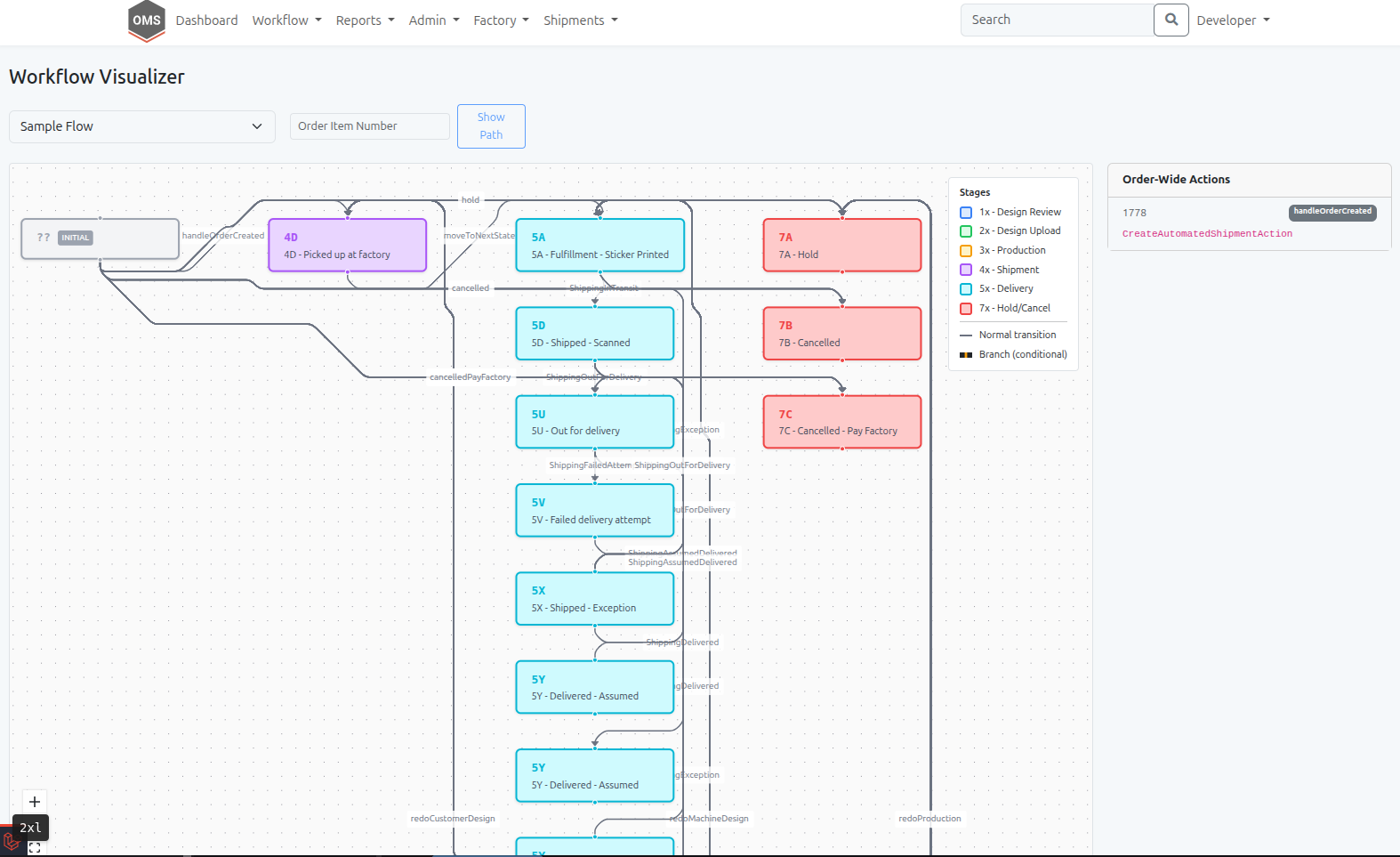
The workflow, drawn out
Every box is a step an order line can sit in, grouped by stage: design review, production, shipment, delivery and hold/cancel. The arrows are the transitions that are allowed - including the branches for exceptions like a failed delivery or production that has to be redone.
Enter an order number and you see the exact route that line took. Handy when a customer calls, and handier still the moment you need to agree on how the process is actually supposed to run.
Workflow per order line
A state machine per line: which step it is in, which actions are allowed and which rules have to pass before it can move on. From design check to production, packing and shipping. An exception is a branch in the workflow, not an email to customer service.
Multiple suppliers and 3PLs
Order lines are assigned to whoever makes or ships them. Everyone only sees their own work, in their own screen or through an integration. At Dutch Label Shop, five fulfilment partners run side by side in the same system.
Tracking and notifications
Tracking data from carriers and fulfilment partners comes in, moves the order line to the next step automatically and goes back to your webshop. The customer gets their email from Magento. Nobody retypes anything.
Production costs and margin
For every order line we record what making it actually cost, including exchange rate and shipping surcharge at the moment of check-in. That gives you margin per product and per supplier - not at the quarterly close.
Permissions and scoping
Who sees what is not a UI trick but a filter on the data itself. A supplier only sees the orders assigned to them, a team lead only their own role. That saves a lot of explaining the moment an external party joins.
Documents and customs
Packing slips, customs forms and region-specific documents are generated the moment a shipment is put together. Including the rules per country, because you do not want to work those out twice.
The platform is there. Your process is the custom work.
We do not build an OMS from scratch every time. The foundation is in place: users and teams, permissions down to record level, a full audit trail through event sourcing, forms, settings, integrations and an admin interface that already looks finished. That is exactly the part that swallows the first months of a custom project.
What remains is the only thing that really matters: your states, your actions and your rules. Which steps an order goes through at your company, who may take which step, what has to be true before they can, and what happens automatically afterwards. We configure that, we do not program it from zero.
The practical upshot: you see your own process running within weeks instead of after six months. And when the process changes - and it will - that is a workflow change, not a rebuild.
Next to your webshop, not inside it
The OMS runs as its own application alongside Magento. That is a deliberate choice: you can upgrade your webshop without pausing fulfilment, and change your production process without a shop release. The integration runs over the API - orders in, statuses and tracking out.
What we need from you

The software is the easy part. The hard part is that your process currently lives in people's heads, and it has to come out before we can build it. At almost every client that surfaces things that have "just worked that way" for years.
We do that together, but it costs time on your side - from people who are busy, because those are exactly the people who know how it works. Plan for it and nobody gets surprised halfway through.
The first step is mapping your order flow
We start with a process analysis: a scoped engagement of a few weeks in which we map your order flows, dig up the exceptions and chart the integrations. You get an implementation plan with an estimate under it, and you know where it is going to hurt before a single line of code is written.
A baseline measurement is part of that. How many manual steps sit between "ordered" and "shipped" today, how many orders are delayed because somebody missed an email, and what a shipment to the wrong address or the wrong country costs you. Those numbers are already in your systems - nobody has ever put them side by side.
This system did not come out of a product roadmap. We built it for Dutch Label Shop, where every label is made per order and shipments go all over the world. It has been running in production there for years. So what you get is not a version 1.0, but the same foundation with your process on top.