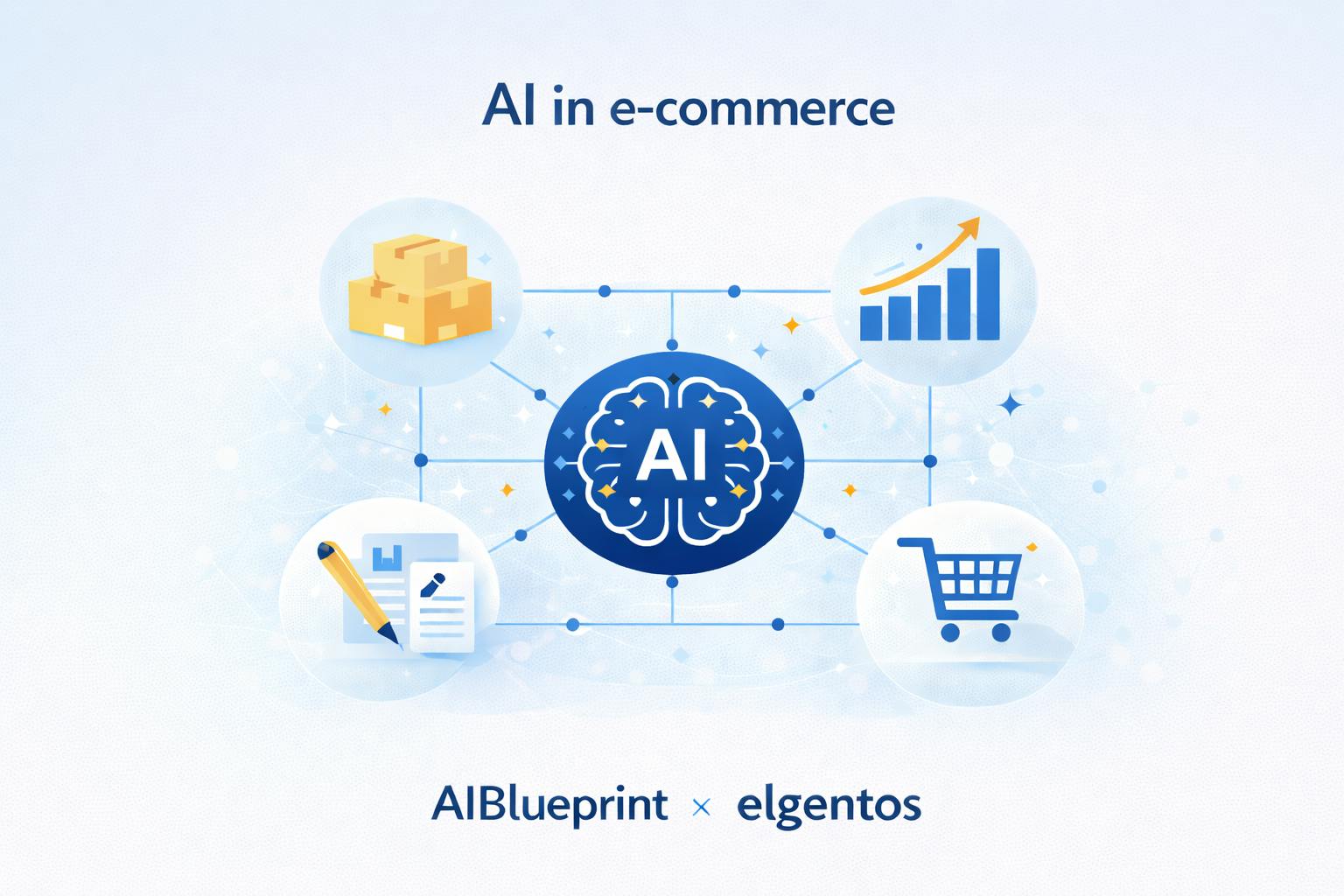
At Elgentos, we regularly organize a webinar in which we discuss current topics together with experts. This time, we spoke with Jantine Doornbos from AIBlueprint. The topic of this session: AI readiness.
Many organizations feel they need to be doing something with AI. There's experimentation with tools like ChatGPT, internal pilots are being launched, and ideas about automation are emerging. But the strategic foundation is often missing. What does it really mean to be AI-ready? And what steps do you need to take to implement AI successfully and responsibly?
Why AI readiness matters
AI readiness is about the extent to which your organization is prepared to deploy AI. That doesn't just mean having access to tooling, but above all having your processes, data, and vision in order. In practice, we see that companies do have ambition, but don't always know where to start. AI is much more than a smart chatbot; it touches your data foundation, your core processes, and even your governance.
During the webinar, AIBlueprint shared five steps that help organizations achieve AI readiness.
- Everything starts with the problem. AI is not a goal in itself, but a means. So the question is: which concrete problem do you want to solve? This can range from small process improvements to larger strategic issues. Without a clearly defined problem, AI remains an experiment without clear direction.
- Data forms the foundation of every AI application. Yet at many organizations, data turns out to be stored in a fragmented way, poorly structured, or insufficiently secured. For a successful implementation, data needs to be transparent, normalized, and securely accessible. Only then can AI actually add value.
- An important step is taking ethical responsibility. Which data do you use? Are you allowed to use this data for AI? Is the dataset clean and free of bias? Organizations need to make conscious choices here. AI readiness also means thinking about privacy, bias, and transparency.
- The choice of technology plays an important role. Many companies immediately reach for well-known AI platforms, but don't always consider the strategic and legal implications. For European organizations, it's important to deliberately choose tooling that fits within the legislation and is sustainably deployable in the long term. Technology should support your strategy, not the other way around.
- A clear vision on AI policy is essential. What do you want to achieve as an organization with AI in the coming six to twelve months? Where is AI allowed to make decisions independently, and where not? By setting frameworks for this in advance, you prevent fragmented initiatives and create support within teams.
What often goes wrong?
A common pitfall is that organizations start with the tool instead of the strategy. Experiments are run in the hope that it automatically pays off. In reality, AI requires a solid data foundation and a clear connection to the core process.
Another pitfall is that AI gets deployed for isolated applications with a high gimmick factor, but without structural impact. Think of an automatically generated image for a blog post, while the real optimization potential lies in product data, pricing, or process automation. When AI isn't linked to the core process, adoption remains limited and the impact stays small.
What does AI do, and what doesn't it do?
AI is particularly powerful at optimizing existing processes. It speeds up repeatable thinking work, supports analysis, and automates recurring tasks. What AI does less well is creating entirely new business models without human direction. When you deploy AI for completely new processes, you're actually broadening your product offering rather than optimizing it.
The biggest gains often lie in making what you already do smarter and more efficient.
The Elgentos approach to e-commerce AI readiness
At Elgentos, we look specifically at e-commerce organizations. We too apply five key steps to implement AI successfully.
We start with strategic positioning. Where in your organization is AI allowed to support or make decisions? For business-critical or legal processes, human oversight remains essential. AI always works alongside people, not as a replacement.
Next, we focus on data quality and access. Without specific company data, AI is essentially a generic model guessing based on probability. By feeding AI your own, structured data, the output becomes more relevant and consistent.
We then look at process selection. Where in the organization is there repeatable thinking work within clear frameworks? If checking the output takes less time than performing the task itself, AI is often a suitable solution.
Human in the loop is indispensable here. Especially for important business processes, verification remains necessary. AI can support, but final responsibility stays with people.
Finally, continuous evaluation is crucial. AI models need to be monitored and adjusted. Small deviations in output can have major consequences, for example with product information or pricing logic. That's why structural oversight is part of a mature AI strategy.
Is your organization AI-ready?
AI readiness requires deliberate choices. About data. About processes. About technology. And about governance. It starts with insight into your current situation and ends with a strategic, sustainable implementation where people and technology work together.
Curious where your organization stands in terms of AI readiness? We're happy to talk it through and discover together how we can make your e-commerce organization AI-ready.