What Does a Magento Platform Really Cost? Maintenance, Development, and Total Cost of Ownership Explained
Magento is known as a powerful platform for B2B e-commerce. But also as a platform whose costs are difficult to predict.
Many organizations hear stories about expensive upgrades, unexpected maintenance costs, and development projects that keep growing.
The question that often comes up: what does Magento actually cost?
The honest answer: it depends less on the platform itself and more on how you organize maintenance and development.
In this article, we look at the two most important cost streams of Magento: maintenance and feature development. And how companies can get a grip on them in practice.
Why Magento Maintenance and Development Costs Often Seem Unpredictable
Many organizations experience Magento as a platform where maintenance costs and development costs are difficult to predict. Especially with B2B platforms, where custom functionality and integrations are often needed.
This is usually due to the traditional hourly billing model. Companies request new features, developers estimate the work, and send an invoice afterwards based on the number of hours.
Additionally, it is often difficult for organizations to estimate in advance how much development will actually be needed. New integrations, changing product structures, or assortment growth cause the roadmap to keep evolving.
The problem: total costs are difficult to predict in advance.
In some cases, maintenance and updates can run up to hundreds of hours per year, without a clear budget being established beforehand.
For organizations that view their platform as a strategic asset, it can be difficult to make the right trade-offs between maintenance and new functionality.
How Companies Often Try to Solve This
In practice, we see organizations trying different approaches to get a grip on Magento costs.
Postponing maintenance
Some companies postpone updates as long as possible. This seems cheaper in the short term, but often leads to bigger technical problems in the long run.
Organizing everything internally
Other organizations try to manage Magento entirely in-house. However, this requires specialized knowledge and proves difficult to scale in practice.
Switching to a SaaS platform
A third response is that organizations consider switching to a SaaS platform such as Shopify.
With SaaS platforms you pay a fixed monthly fee that includes hosting, updates, and maintenance. This makes costs predictable and reduces technical complexity.
At the same time, it also means you have less flexibility. Order flows, product structures, and B2B functionality are largely fixed.
Magento is specifically chosen by organizations that want to fully align their digital processes with their business. For companies with complex B2B processes, that flexibility can be decisive.
The Two Cost Streams Within Magento
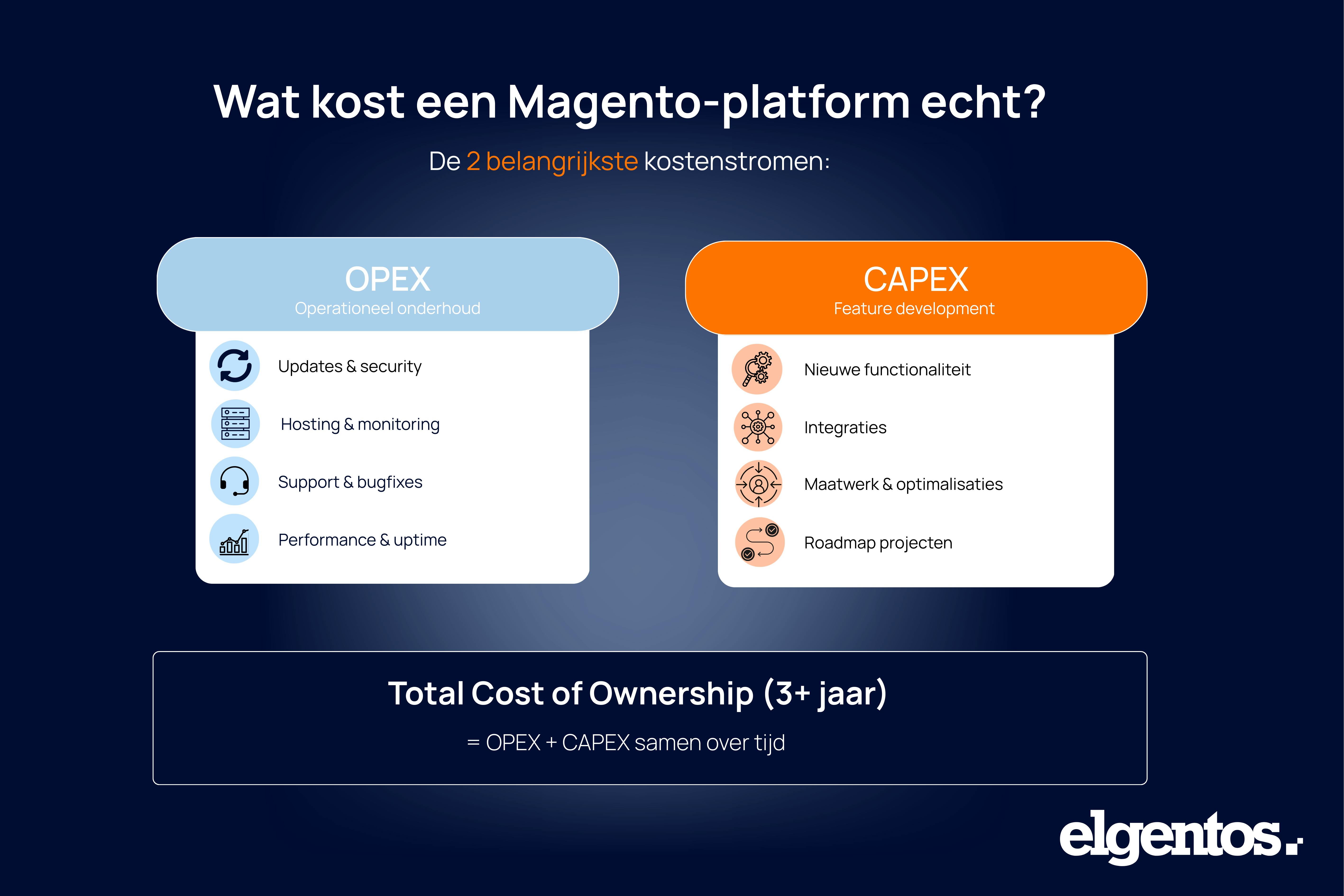
To better understand costs, it helps to split Magento costs into two categories: operational costs and investments.
Operational costs (OPEX): maintenance, updates, and support
Investments (CAPEX): new features and functionality
By separating these two streams, you get a more realistic picture of what a Magento platform actually costs.
The Operational Side: Magento Maintenance and Stability
The first cost stream is operational: keeping the platform running.
This includes:
Magento updates
security patches
bugfixes
monitoring of performance and uptime
compatibility with extensions
In theory, this sounds straightforward. In practice, maintenance is still often postponed.
You can compare it to the maintenance of a house. If you don't paint for years, you'll eventually deal with wood rot. The problem doesn't get smaller. It only gets more expensive to fix.
With e-commerce it's the same.
Platforms that go without updates for a long time become more vulnerable and harder to maintain.
Why Maintenance is Crucial for the Security of Your Platform
Maintenance of a Magento platform is sometimes seen as a technical formality: installing updates, fixing bugs, and occasionally updating an extension.
In reality, maintenance is primarily a security measure.
Magento regularly receives security patches that fix vulnerabilities in the platform. When these updates are not installed, the vulnerabilities remain and that makes a platform an attractive target for attacks.
We regularly see platforms that have not had updates for months or even years. This makes them relatively easy to hack.
A common attack is placing a script that intercepts credit card data during the payment process. To the customer it looks like they are paying safely, while the data is actually being forwarded to an external party.
The consequences can be significant:
data leaks of customer data
reputational damage
possible fines for violating privacy legislation
loss of customer trust
Regular maintenance and security updates are therefore not an optional cost item, but an essential part of a professional e-commerce environment.
The Hidden Costs of Deferred Maintenance
When maintenance is postponed, it seems like a cost saving in the short term.
The platform keeps running. Orders come in and there seems to be no immediate reason to make time and budget available for updates.
But in reality, the risks are accumulating.
Software ages. Extensions become incompatible with newer versions of Magento. Security patches remain pending and the technical debt grows slowly.
At some point, a situation arises where a simple update is no longer sufficient. Instead, a larger technical intervention must take place to make the platform stable and secure again.
This can mean, for example:
upgrading multiple Magento versions at once
replacing extensions that are no longer supported
re-testing or adjusting custom work
reconfiguring integrations
Where regular maintenance often has predictable costs, deferred maintenance can lead to larger and more difficult to plan projects.
That is why more and more organizations are choosing to organize maintenance structurally as a fixed part of their e-commerce operations.
Why Successful Magento Platforms Keep Evolving
A common misconception is that development stops once a platform goes live.
In practice, many organizations continue working on their platform for years.
New product lines, changing customer expectations, and integrations with other systems ensure that new functionalities are continually needed.
Why Successful Magento Platforms Keep Evolving
A common misconception is that development stops once a platform goes live.
In practice, many organizations continue working on their platform for years.
New product lines, changing customer expectations, and integrations with other systems ensure that new functionalities are continually needed.
The companies that get the most return from their platform are often precisely the organizations that keep investing in improvement because their platform is an important part of their growth strategy.
That is exactly why many organizations look not just at individual development projects, but at the Total Cost of Ownership (TCO) of their platform over several years.
What Does a Magento Platform Cost in Practice?
For B2B organizations, it is often more useful not to look at individual project prices, but at the Total Cost of Ownership (TCO) over several years.
The example below shows how the costs of a Magento environment can develop over three years.
| Year | 1 | 2 | 3 | Total |
|---|---|---|---|---|
| Discover & Build | €18k | - | - | €18k |
| Implementation of house style & theme | €30k | - | - | €30k |
| Custom work (post-delivery) | €30k | - | - | €30k |
| Expand & Build (development) | - | €10k | €10k | €20k |
| Optimize & Build (Magento Total Care) | €18k | €18k | €18k | €54k |
| SLA | €10k | €10k | €9k | €20k |
| Hosting + infrastructure | €6k | €6k | €6k | €18k |
Total investment over three years: approximately €198,200.
What stands out:
Year 1 is the most expensive, because the implementation and customization take place.
After that, costs largely stabilize.
The most important cost item shifts to maintenance and ongoing development.
This type of overview helps organizations approach e-commerce as a structural investment rather than a series of separate projects.
The most important step to make Magento costs predictable is separating two things: operational maintenance (OPEX) and ongoing innovation (CAPEX).